”One might think the fallacy would be so obvious that no one would ever commit it, but that is not the case.”1
Etymology:
- The Latin term “Circulus in Probando” translates to “a circle in proof”.
Definition:
- When the beginning and the end of a chain of proof are the same, it’s called the Circular Reasoning Fallacy.
- The argument circles back on itself without providing independent explanation/evidence for its claim.
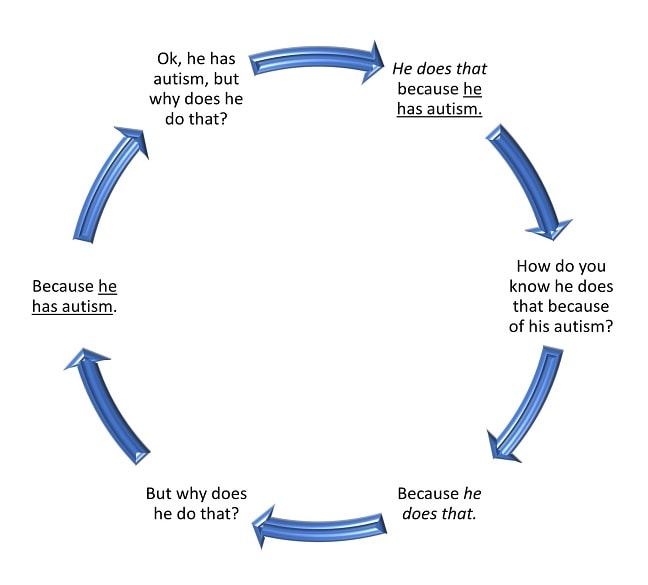
Avoiding the Pitfalls of Circular Reasoning by ASAT
Details:
Circular Reasoning is an informal fallacy. The argument goes: X happens due to Y, Y happens due to Z, and Z happens due to X. This is a circular argument.
Types of Circular Reasoning:
-
Petitio Principii (Begging the Question): Happens when the premise already includes the conclusion.
- Restating the Conclusion: Restating the conclusion but using different words to make it sound more reasonable.
- Example:
- X: “A taxation system of that kind will never succeed, because it cannot work.”
- Counter:
- Ask for an explanation: “Can you please explain why the taxation system cannot work?”
- Example:
- Assuming Unstated Premises: Relying on premises that are unstated or unexplained.
- Example:
- X: “We must reduce taxes to improve the economy.”
- Y: “How will reducing taxes improve the economy?”
- X: “Because the best way to improve the economy is to reduce the taxes.”
- Counter:
- Challenge the unexplained premise: “Is there any data that supports what you are stating?”
- Example:
- Loaded Question: Assumes something to be true without explaining why.
- Example:
- X: “Have you stopped beating your wife?”
- (Assumes you are beating your wife, and either answer “Yes” or “No” will mean that you have beaten your wife.)
- Counter:
- Directly address the assumption: “I do not condone any violence in my relationship.”
- Highlight the flaw: “You are assuming that I’m beating my wife without any evidence. It is childish to use such Loaded Questions.”
- Example:
- Restating the Conclusion: Restating the conclusion but using different words to make it sound more reasonable.
-
Circulus in Definiendo (Circular Definition): A term defined using itself, or using a term that is defined by it.
- Example:
- X: “A crime is an act punishable by criminal law.”
- You: “What makes a law criminal?”
- X: “Criminal law is the body of law that defines crimes and sets their punishments.”
- (The circle is crime → criminal law → crime. Nothing outside the pair anchors either term. Someone who doesn’t already know what a crime is learns nothing from either sentence.)
- Counter:
- Run the substitution: Put the second definition back into the first. “A crime is an act punishable by the body of law that defines crimes.” The term reappears inside its own definition. That’s the circle, and now the proponent can see it instead of just being told about it.
- Supply an independent anchor: “Criminal law is defined by procedure, not content. The state prosecutes in its own name, the standard of proof is beyond reasonable doubt, and the sanction is penal rather than compensatory. A crime is any act that triggers that machinery.”
- Example:
-
Circular Explanation: Restates the original assertion without adding anything new.
- Example:
- X: “Why do we need laws?”
- Y: “Because without laws, we would have anarchy.”
- X: “What is anarchy?”
- Y: “It is a situation where there are no laws.”
- Counter:
- Ask for an explanation: “Can you explain how the lack of laws leads to anarchy?”
- Example:
-
Assuming the Conclusion: As the name implies, it’s when the conclusion is assumed already.
- Example:
- X: “Lying is wrong because it’s wrong to lie.”
- (No explanation has been given on why it is wrong; it just assumes that lying is wrong.)
- Counter:
- Ask for an explanation: “Can you explain why exactly lying is wrong?”
- Example:
Why?
Why is it a Fallacy?
The reason why Circular Reasoning is a fallacy is because it is fallacious. Nah, I’m kidding. It is a fallacy because to prove something or to disprove it, you need independent confirmation/evidence. Circular Reasoning repeats its own claims without external verifiable confirmation. It creates a circular chain where it tries to validate itself but fails. Similar to attempting to lift yourself by pulling your own leg, nothing happens, and at worst, you fall down.
Why would someone do this?
Different reasons exist for using various types of circular reasoning fallacies.
- Lack of Knowledge on Logic: Some fallacies, like Assuming Unstated Premises or Restating the Conclusion, might come from a lack of understanding of logical reasoning.
- Deception: Loaded questions are used to deceive by assuming something negative about the proponent.
- Making a Point Without Knowledge: Circular Explanation and Assuming the Conclusion fallacies can happen when a proponent tries to make a point or wants to say something without any knowledge.
When Is It Fair to Use?
Never, that’s it, never.