Abstract
During and after the “Quota Reform” / “Anti-Discriminatory” Protests, which ultimately caused the overthrowing of the ruling dictatorial party “Awami League,” the word “Fascist” has been thrown around. This is not only wrong but also dangerous. That is why I compiled this paper, describing “Fascism” and its characteristics, and then presenting arguments for and against the usage of “Fascism.”
Introduction
The term “Fascism” has gained increased attention post-student revolution in Bangladesh. This paper seeks to explore the illogical application of the term. The phenomenon of labeling political opponents as “Fascists” not only hampers political debate but also distorts history and undermines political ideologies.
Contextual Background
This paper provides a comprehensive context on major political parties like Awami League, Bangladesh Nationalist Party (BNP), and Jamaat-e-Islami, as well as the revolution during which the misuse of the term “Fascism” started peaking.
Historical Misuse of the Term
This paper reviews various instances of the term’s misuse, including trends identified through Google Trends and media usage. By analyzing how figures like Dr. Muhammad Yunus, Nurul Haq Nur, and media outlets such as Jamuna TV and The Daily Star use the term, the paper criticizes their application of the term “Fascism”
Conceptual Clarification
A comprehensive definition of fascism, its characteristics, and the actions of an actual fascist parties will be provided. Local political parties will then be compared against this definition. This will clarify the concept of fascism and explain why calling them “Fascist” is incorrect.
Purpose
The purpose of this paper is to protect history and political theory by demonstrating that indiscriminately labeling opposition parties as “Fascist” is both incorrect and dangerous. Maintaining an accurate categorization system is essential because baseless accusations do more harm than good. Simplifying a fully developed ideology is an invalid approach.
Context
A comprehensive context on political and social events leading to the misuse of the term “Fascism” in Anno Domini 2024
Political Parties
A simplified overview of major political parties in Bangladesh and their ideologies.
Awami League
The Awami League is a major political party in Bangladesh, known for its significant contributions to the 1971 East Pakistani War of Independence, which led to the formation of modern-day Bangladesh. In theory, the Awami League follows Mujibism as its fundamental policy. Although originally left-wing, it has evolved into a centrist party. It has become an authoritarian powerhouse that suppresses opposition and embraces a form of political nationalism that marginalizes other parties. Philosophically, the Awami League is pragmatic.1
- N.B: The true ideological position of the Awami League on the left-right spectrum is debated; thus, centrism has been chosen as the most neutral descriptor.
Mujibism
Mujibism is based on four core fundamental principles:23
- Nationalism
- Socialism
- Secularism
- Democracy
Bangladesh Nationalist Party (BNP)
The Bangladesh Nationalist Party (BNP) is another major political party in Bangladesh, formed during the political vacuum caused by the 1975 coup. Over the years, it has shifted towards a more right-wing stance. The party’s core political ideology is Bangladeshi nationalism, rooted in the country’s history, culture, and territory. The Bangladesh Nationalist Party (BNP) also incorporates Islamic values, reflecting the majority religion of Islam in Bangladesh. However, it maintains a moderate stance, advocating for religious freedom without endorsing a theocracy.4
Founding Principles of Bangladesh Nationalist Party (BNP)
According to the party’s official website, the founding principles of the Bangladesh Nationalist Party (BNP) are:
- “Full faith and trust in Allah”
- Bangladeshi nationalism
- Democracy
- Socialism, “in the sense of economic and social justice”
Jamaat-e-Islami
The Jamaat-e-Islami is a prominent Islamist political party in Bangladesh, originating from the British Raj. Its core ideology is Islamic statehood, aiming to establish a state governed by Sharia law. The party emphasizes implementing Islamic principles and outlawing “un-Islamic” practices. It is far-right wing and has faced controversy and legal challenges due to its role in the 1971 East Pakistani War of Independence and its association with war crimes.5
Founding Principles of Jamaat-e-Islami
The Jamaat-e-Islami is guided by the following principles:
- Establishment of an Islamic state through political power.
- Implementation of Sharia law in governance.
- Opposition to secularism and “un-Islamic” practices.
Quota Reform Movement and Non-Cooperation Movement (2024)
Quota Reform Movement
The 2024 Bangladesh quota reform movement, also known as the July Revolution or the Student Revolution, was a major protest initiated by university students from institutions such as Dhaka University, Chittagong University, and BRAC University. The movement demanded reform to the government job quota system. The Supreme Court decided to reinstate a 30% quota for the descendants of freedom fighters from the 1971 East Pakistani War of Independence. Students began protesting against this decision. In early June 2024, the protests intensified when Awami League leader Sheikh Hasina made remarks interpreted as derogatory toward the students, referring to them as “Rajakar” — traitors who had betrayed their country. The Awami League responded by deploying its student wing, the “Chatra League,” to attack the protesters with knives, blades, and wooden bats. The government’s attempt to suppress the movement included closing educational institutions, deploying armed forces, and imposing a nationwide curfew and internet blackout. The situation escalated, and the government began using live ammunition against students. By August 2, confirmed casualties included 215 deaths and over 20,000 injuries, with unofficial estimates ranging from 300 to 500 deaths, including at least 32 children. The government’s restrictions on information further complicated casualty reports. Amid the unrest, the movement’s demands expanded to include accountability for the violence, a ban on the Chatra League, and the resignation of Prime Minister Sheikh Hasina.
Non-Cooperation Movement
The non-cooperation movement, also known as the one-point movement, emerged from the quota reform protests. Its primary demand was the resignation of Prime Minister Sheikh Hasina and her cabinet. Fueled by escalating violence and socio-economic issues, the movement gained momentum on August 3, 2024, when protest coordinators called for “comprehensive non-cooperation.” Clashes on August 4 led to 97 deaths, including students.
Fall of Awami League
The movement culminated in a large march on August 5, which pressured Hasina to resign and flee to India. Following her departure, a new interim government was formed under economist and Nobel laureate Muhammad Yunus. The removal of Hasina led to widespread celebrations and unrest throughout the nation.
Increased Usage of the Term “Fascism”
Google Trends
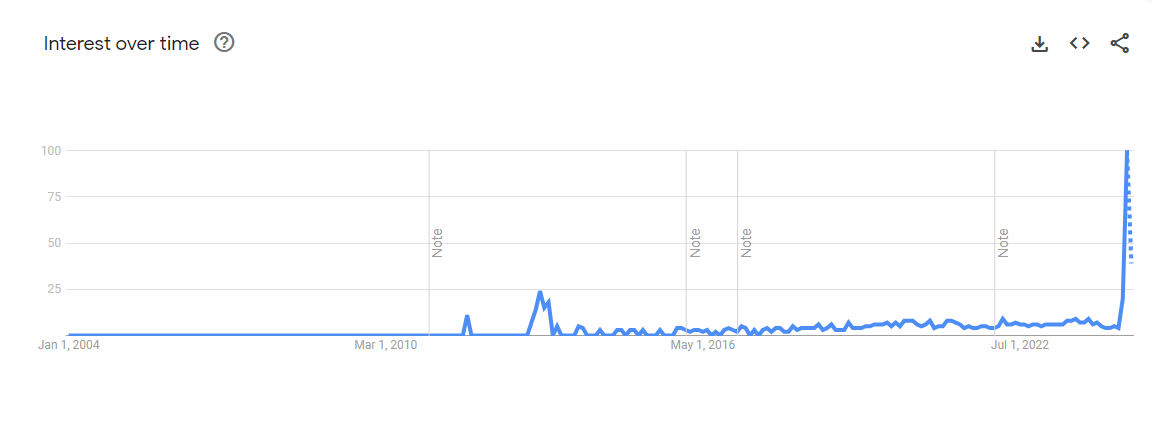
Google trends for “Fascism” in Bangladesh (1 Jan, 2004 → 9 Sep, 2024)
Media Usage
Dr. Muhammad Yunus (Chief Advisor of Bangladesh)

“ফ্যাসিবাদী সরকার লুটপাট করার জন্য নতুন করে ৬০ হাজার কোটি টাকা ছাপিয়ে বাজারে ছাড়ার কারণে মুদ্রাস্ফীতির শিকার হয়েছে দেশের মানুষ।” → “The people of the country have become victims of inflation due to the fact that the fascist government released 60 thousand crores of rupees in the market for looting.”6
Nurul Haq Nur (Bangladeshi activist and politician)
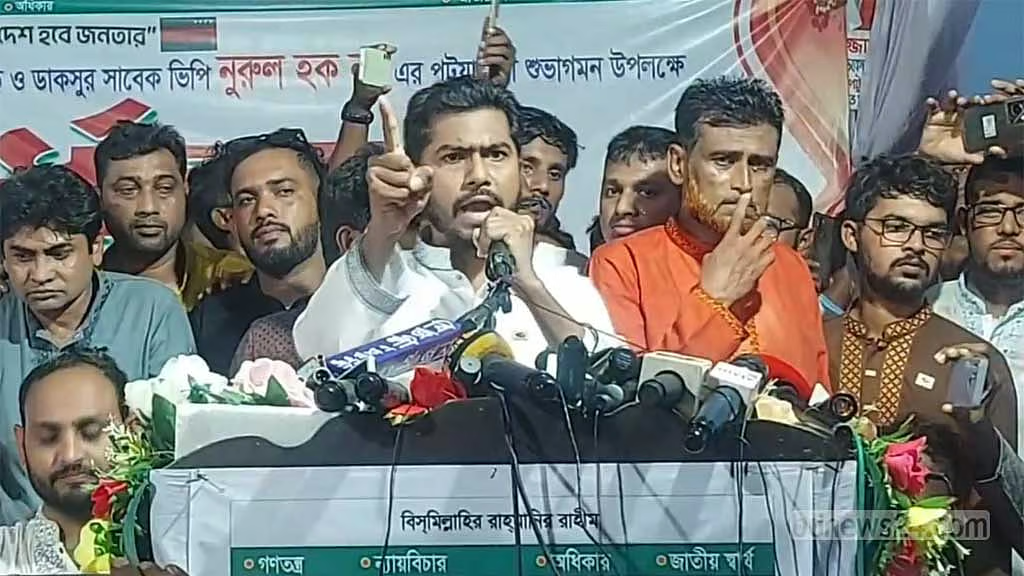
“বিএনপির মধ্যে ‘ফ্যাসিবাদের’ পদধ্বনি শুনছেন নুর” → “Nur is hearing the footsteps of ‘fascism’ in BNP”7
Asif Mahmud (Advisor of Youth and Sports)
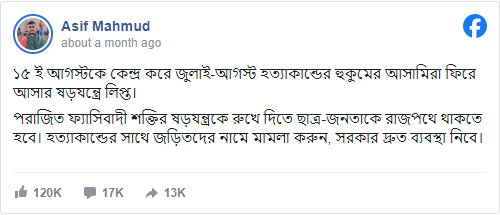
“১৫ ই আগস্টকে কেন্দ্র করে জুলাই-আগস্ট হত্যাকান্ডের হুকুমের আসামিরা ফিরে আসার ষড়যন্ত্রে লিপ্ত।
পরাজিত ফ্যাসিবাদী শক্তির ষড়যন্ত্রকে রুখে দিতে ছাত্র-জনতাকে রাজপথে থাকতে হবে। হত্যাকান্ডের সাথে জড়িতদের নামে মামলা করুন, সরকার দ্রুত ব্যবস্থা নিবে।”
→ “Around August 15, the accused in the July-August killing order are involved in a conspiracy to return.
Students must be on the streets to stop the conspiracy of the defeated fascist forces. File a case in the name of those involved in the murder, the government will take swift action.”8
Jamuna TV
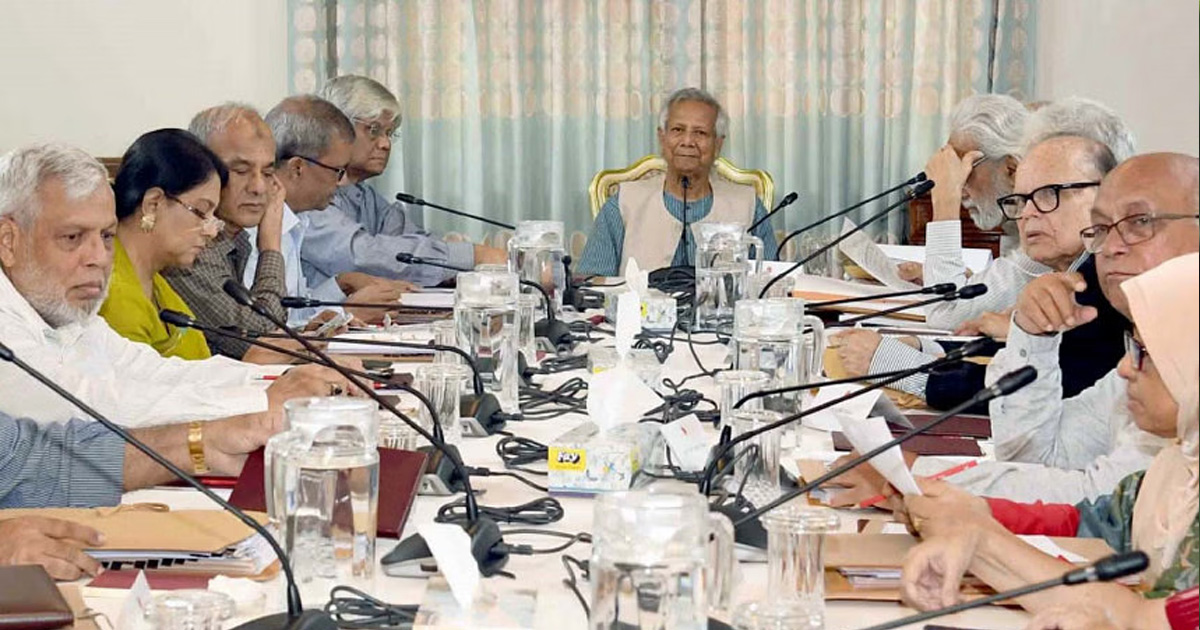
“বিচার না হওয়া পর্যন্ত ফ্যাসিবাদী দল কার্যক্রম চালাতে পারবে না’” → “The Fascist Party cannot operate until the trial is over”9
The Daily Star
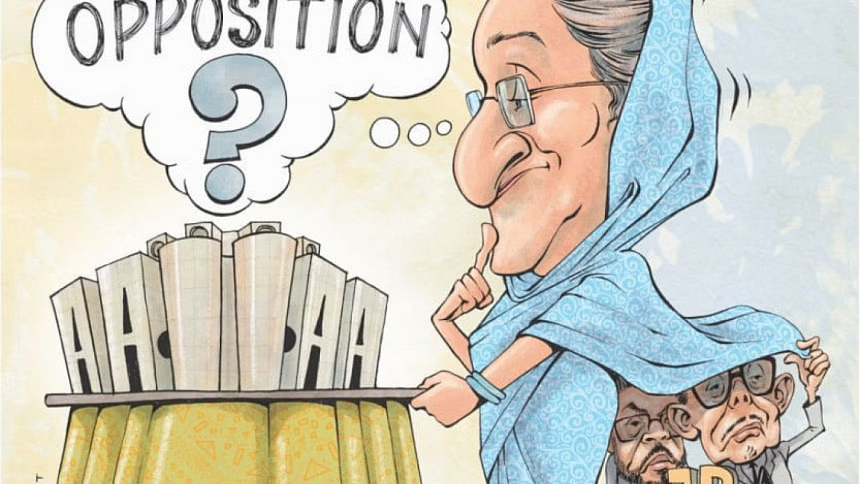
“Awami League: From Progressive Politics to Fascism”10
Fascism
Definitions:
United States Holocaust Memorial Museum
“Fascism is an ultranationalist, authoritarian political philosophy. It combines elements of nationalism, militarism, economic self-sufficiency, and totalitarianism. It opposes communism, socialism, pluralism, individual rights and equality, and democratic government.”11
Wikipedia
“Fascism is a far-right, authoritarian, ultranationalist political ideology and movement, characterized by a dictatorial leader, centralized autocracy, militarism, forcible suppression of opposition, belief in a natural social hierarchy, subordination of individual interests for the perceived good of the nation or race, and strong regimentation of society and the economy. Opposed to anarchism, democracy, pluralism, egalitarianism, liberalism, socialism, and Marxism, fascism is placed on the far-right wing within the traditional left–right spectrum.”12
Merriam Webster
“A political philosophy, movement, or regime (such as that of the Fascisti) that exalts nation and often race above the individual and that stands for a centralized autocratic government headed by a dictatorial leader, severe economic and social regimentation, and forcible suppression of opposition”13
Common Characteristics of Fascism (Compiled from multiple sources)14
- State over the individual (Core Ideology)
- Race/Ethnic Hierarchy (Core Ideology)
- Extreme Nationalism and Xenophobia (Core Ideology)
- Far Right (Core Ideology)
- Totalitarian Aspiration
- Authoritarian Leadership
- Militarism
- Anti-Democratic Ideology
- Suppression of Dissent
- Cult of Tradition and Purity
- Corporate and State Power Alignment
- Scapegoating of Enemies
- Disdain for Intellectualism and the Arts
- Populist Appeal
- Reactionary Ideology
- Obsession with Law and Order
- Sexism and Gender Norms
- Manipulation of Media
- N.B: (Core Ideologies) are mandatory for a Party to be Fascist.
Actions of Fascism15
- A sense of overwhelming crisis beyond the reach of any traditional solutions.
- The primacy of the group, toward which one has duties superior to every right, whether individual or universal, and the subordination of the individual to it.
- The belief that one’s group is a victim, a sentiment that justifies any action, without legal or moral limits, against its enemies, both internal and external.
- Dread of the group’s decline under the corrosive effects of individualistic liberalism, class conflict, and alien influences.
- The need for closer integration of a purer community, by consent if possible, or by exclusionary violence if necessary.
- The need for authority by natural chiefs (always male), culminating in a national chieftain who alone is capable of incarnating the group’s historical destiny.
- The superiority of the leader’s instincts over abstract and universal reason.
- The beauty of violence and the efficacy of will, when they are devoted to the group’s success.
- The right of the chosen people to dominate others without restraint from any kind of human or divine law, right being decided by the sole criterion of the group’s prowess within a Darwinian struggle.
Example of Multiple Fascist Actions: Nazi Germany (1933–1945)
Nazi Germany under Adolf Hitler provides a prime example that encompasses many of the actions Paxton describes in The Anatomy of Fascism:15
- Sense of Overwhelming Crisis Beyond the Reach of Traditional Solutions
- After World War 1, Germany was left in a state of economic and political crisis. The Treaty of Versailles, hyperinflation, and the Great Depression all contributed to a national crisis. The Nazis capitalized on this opportunity, portraying themselves as the one and only solution to this overwhelming crisis; No traditional solution will be effective.
- Primacy of the Group and Subordination of the Individual
- The Nazi regime emphasized the importance of the Aryan race (the group) above everything else. They demanded that individuals sacrifice personal rights and freedoms for the greater good of the people. The individual had a duty to the entire group, and any form of dissent or disagreement was seen as an act of treason.
- Belief in Victimhood and Justification for Unrestrained Actions
- Nazis promoted the idea that Germany was a victim of the Jewish people, the Treaty of Versailles, and international communism. This “victimhood” was used to justify their extreme actions, such as the Nuremberg Laws (which legalized anti-Semitism) and the eventual genocide of millions of Jews during the Holocaust.
- Closer Integration of a “Purer” Community
- Nazi ideology sough to “purify” the Aryan race, first through the exclusion of Jews and other minorities, and eventually through the genocidal violence of the Holocaust. The Nazis pursued this racial purity via consent (through propaganda and indoctrination) and violence (through the SS and Gestapo).
- Authority of Natural Chiefs, Culminating in a National Chieftain
- Adolf Hitler was seen as the ultimate leader, or Führer, embodying Germany’s destiny and will. His authority was unquestionable, and he was regarded as a natural leader destined to restore the German people to their rightful place.
- Superiority of the Leader’s Instincts Over Abstract Reason
- Hitler’s decisions were often framed as being driven by instinct and the will of the people, rather than reason or logic. Nazi propaganda emphasized his genius, portraying him as a figure who transcended rational thought.
- Right to Dominate Others Without Moral Restraint
- Hitler’s vision for Germany involved the domination of Europe. Other races were considered inferior and thus rightfully subjugated or exterminated. The invasion of Poland, the enslavement of Slavic peoples, and the genocide of Jews and Romani populations were justified as necessary for the survival and dominance of the German/Aryan “master race.”
Arguments Around the Term “Fascism”
Arguments For:
Initial Usage
I believe that the initial usage of this term was intended to insult the Awami League. Due to confirmation bias, people chose oversimplified definitions and began using it as a genuine categorization.
Over-Simplified Definitions
Many arguments for insisting on the usage of the word “Fascism” rely on oversimplified definitions. Most of these sources, such as Simple Wikipedia and Merriam-Webster, define fascism in a simplistic manner:
- “A tendency toward or actual exercise of strong autocratic or dictatorial control”16
- “A political system headed by a dictator in which the government controls business and labor and opposition is not permitted”17
- “Fascism is a far-right form of government in which most of the country’s power is held by one ruler or a small group, under a single party. Fascist governments are usually totalitarian and authoritarian one-party states.”18
Ad Populum (Appeal to Popularity)
Most people in this country prefer to follow popular ideas over facts. The chief advisor, a Nobel Laureate, using this word due to its popularity does not support my argument. The simple reason people want to believe these parties are “Fascist” is because of the overuse and popularity of the term. After the initial accusations, the momentum never stopped.
“People Wouldn’t Understand”
One of the leading points is that accurate terminology wouldn’t be understood by the general masses, who might lack the vocabulary to grasp more complicated terms like “Authoritarian right wing.” I would like to argue that, in these scenarios, using the term “Dictatorship” works just fine. In fact, “Dictator” is much more popular than “Fascist.” There is no valid reason to go out of the way to use incorrect terminology.
Arguments Against:
Why They Are Not “Fascist”
Characteristics
| Fascism Characteristic | Awami League | BNP | Jamaat-e-Islami |
|---|---|---|---|
| State over the Individual | No, accused of compromising national interests | Partially; focuses on sovereignty | Core ideology; seeks an Islamic state with Sharia law |
| Race/Ethnic Hierarchy | None | Minimal | None |
| Extreme Nationalism and Xenophobia | Moderate nationalism, less xenophobia | Strong nationalism, moderate xenophobia | Strong nationalism, anti-secular, promotes Islamic values |
| Far Right | Center-right with authoritarian tendencies | Right-wing, conservative | Far-right with a focus on Islamic statehood |
| Totalitarian Aspiration | Authoritarian, but not totalitarian | Authoritarian tendencies | Aspires for total control under Islamic law |
| Authoritarian Leadership | Authoritarian in practice | Authoritarian tendencies | Authoritarian, with a focus on religious leadership |
| Militarism | Limited, used during crises | Moderate, not a core feature | Strong, especially for Sharia law implementation |
| Anti-Democratic Ideology | Suppresses dissent but maintains a democratic façade | Generally supports democratic processes | Anti-democratic, aims for an Islamic state |
| Suppression of Dissent | Suppresses opposition and dissent | Moderate suppression during unrest | Strong suppression of dissent, especially against non-Islamic views |
| Cult of Tradition and Purity | Promotes Bangladeshi nationalism | Promotes nationalism with a historical focus | Promotes Islamic purity and tradition |
| Corporate and State Power Alignment | Aligns with business interests | Moderate alignment, influenced by economic interests | Strong alignment with Islamic values and organizations |
| Scapegoating of Enemies | Scapegoats opposition parties and foreign entities | Scapegoats rivals and external factors | Scapegoats secularism and non-Islamic practices |
| Disdain for Intellectualism and the Arts | Limited disdain, though some political control | Limited disdain | Disdain for secular intellectualism and arts |
| Populist Appeal | Strong populist appeal | Strong populist appeal | Limited populist appeal, focuses more on religious leadership |
| Reactionary Ideology | Pragmatic, responds to political challenges | Conservative, reacts to political challenges | Reactionary against secularism and modernity |
| Obsession with Law and Order | Emphasis on law and order | Emphasis on law and order | Strong emphasis on Sharia law and order |
| Sexism and Gender Norms | Moderate, with traditional gender norms | Traditional gender norms | Strong adherence to traditional gender roles under Islamic law |
| Manipulation of Media | Controls media to suppress dissent | Less control, influenced by political needs | Controls media to align with Islamic views |
- Awami League: Displays some authoritarian traits and strong media control but lacks the far-right and totalitarian aspects of fascism. No racial hierarchy is present.
- BNP: Shows authoritarian and nationalist tendencies but operates within a democratic framework, albeit with some suppression of opposition.
- Jamaat-e-Islami: Shows several fascistic traits, particularly in its goal for an Islamic state and authoritarian governance, yet focuses on Sharia law rather than traditional fascism.
Actions
None of these parties followed the actions of a true fascist party.
Conclusion
Therefore, none of the groups/parties can be classified as “Fascist.” They can be considered authoritarian parties, but not fascist.
Why Calling Them “Fascist” is Dangerous
Dilutes Political Theory
Misapplying the term “Fascism” undermines the complexity and specificity of political theory. By labeling non-fascist groups as fascist, we blur the distinctions between ideologies, which restricts meaningful discourse and understanding.
Dilutes History
The historical context of fascism, rooted in early 20th-century European politics, becomes obfuscated when the term is used without a proper basis. Accurate historical analysis is compromised when “Fascism” is applied to varied and often unrelated political movements.
False Usage
Using “Fascism” inaccurately can lead to misinformed opinions and policy decisions. It creates false equivalencies between ideologies, which can mislead the public and hinder effective political critique and action.
Conclusion
In summary, precise terminology is crucial for accurate political discourse. Mislabeling political entities as “Fascist” not only distorts historical and theoretical understanding but also risks misleading public perception. It is essential to use political terms with accuracy to ensure clear and effective communication in political analysis.
References
Footnotes
-
Wikipedia contributors, “Awami League,” Wikipedia, September 10, 2024, section on Ideology and Policies, https://en.wikipedia.org/wiki/Awami_League. ↩
-
Wikipedia contributors, “Mujibism,” Wikipedia, September 9, 2024, section on Principles, https://en.wikipedia.org/wiki/Mujibism. ↩
-
Abu Md. Delwar Hossain and Md. Rahmat Ullah, eds., Bangabandhur Manobadhikar Darshon (বঙ্গবন্ধুর মানবাধিকার-দর্শন) [Bangabandhu’s View of Human Rights] (Dhaka: National Human Rights Commission, 2013), 16–25. ↩
-
Wikipedia contributors, “Bangladesh Nationalist Party,” Wikipedia, September 11, 2024, section on Ideology, https://en.wikipedia.org/wiki/Bangladesh_Nationalist_Party. ↩
-
Wikipedia contributors, “Bangladesh Jamaat-e-Islami,” Wikipedia, September 11, 2024, https://en.wikipedia.org/wiki/Bangladesh_Jamaat-e-Islami. ↩
-
Muhammad Yunus, “জাতির উদ্দেশে প্রধান উপদেষ্টার ভাষণ [Chief Advisor’s Speech on Addressing the Nation],” Jamuna TV, YouTube video, September 11, 2024, https://youtu.be/kHpLGF8KIOc; The Metro TV, YouTube video, https://youtu.be/uHxX8nwb-ug. ↩
-
Nurul Haq Nur, “বিএনপির মধ্যে ‘ফ্যাসিবাদের’ পদধ্বনি শুনছেন নুর,” bdnews24, September 7, 2024, https://bangla.bdnews24.com/samagrabangladesh/2faac19da141. ↩
-
Asif Mahmud, “১৫ ই আগস্টকে কেন্দ্র করে জুলাই-আগস্ট হত্যাকান্ডের …,” Facebook, August 12, 2024, https://www.facebook.com/asifmahmudofficial07/posts/pfbid02Av5khZdCPDs1By1jkUVdYbD9nsnTwoRisZzm6JdQQkVJX6EqPp2kZx6oMxRFCDPl. ↩
-
Ragib Hosan, “‘বিচার না হওয়া পর্যন্ত ফ্যাসিবাদী দল কার্যক্রম চালাতে পারবে না’,” Jamuna Television, September 5, 2024, https://jamuna.tv/news/560913. ↩
-
Nihad Nowsher, “Awami League: From Progressive Politics to Fascism,” The Daily Star, August 18, 2024, https://www.thedailystar.net/opinion/views/news/awami-league-progressive-politics-fascism-3679516. ↩
-
United States Holocaust Memorial Museum, “Fascism,” Holocaust Encyclopedia, accessed September 9, 2024, section on Definition and Beliefs, https://encyclopedia.ushmm.org/content/en/article/fascism-1#definition-and-beliefs-0. ↩
-
Wikipedia contributors, “Fascism,” Wikipedia, September 9, 2024, https://en.wikipedia.org/wiki/Fascism. ↩
-
Merriam-Webster, “Fascism,” Merriam-Webster Dictionary, September 5, 2024, https://www.merriam-webster.com/dictionary/fascism. ↩
-
Lawrence W. Britt, “Fascism Anyone?: 14 Characteristics of Fascism,” Free Inquiry 20 (2003), https://voxpopulisphere.com/2017/08/23/lawrence-britt-14-characteristics-of-fascism/. ↩
-
Robert O. Paxton, The Anatomy of Fascism (New York: Vintage Books, 2004), 311, http://ci.nii.ac.jp/ncid/BA73068075. ↩ ↩2
-
J. W. Aldridge, “Fascism,” Merriam-Webster Dictionary, n.d., https://www.merriam-webster.com/dictionary/fascism. ↩
-
Merriam-Webster, “Fascism,” Merriam-Webster Dictionary, section on Kids Definition, https://www.merriam-webster.com/dictionary/fascism. ↩
-
Simple English Wikipedia contributors, “Fascism,” Simple English Wikipedia, https://simple.wikipedia.org/wiki/Fascism. ↩